











IT Service Management 4.9 16 Weeks

AWS Develops training Course

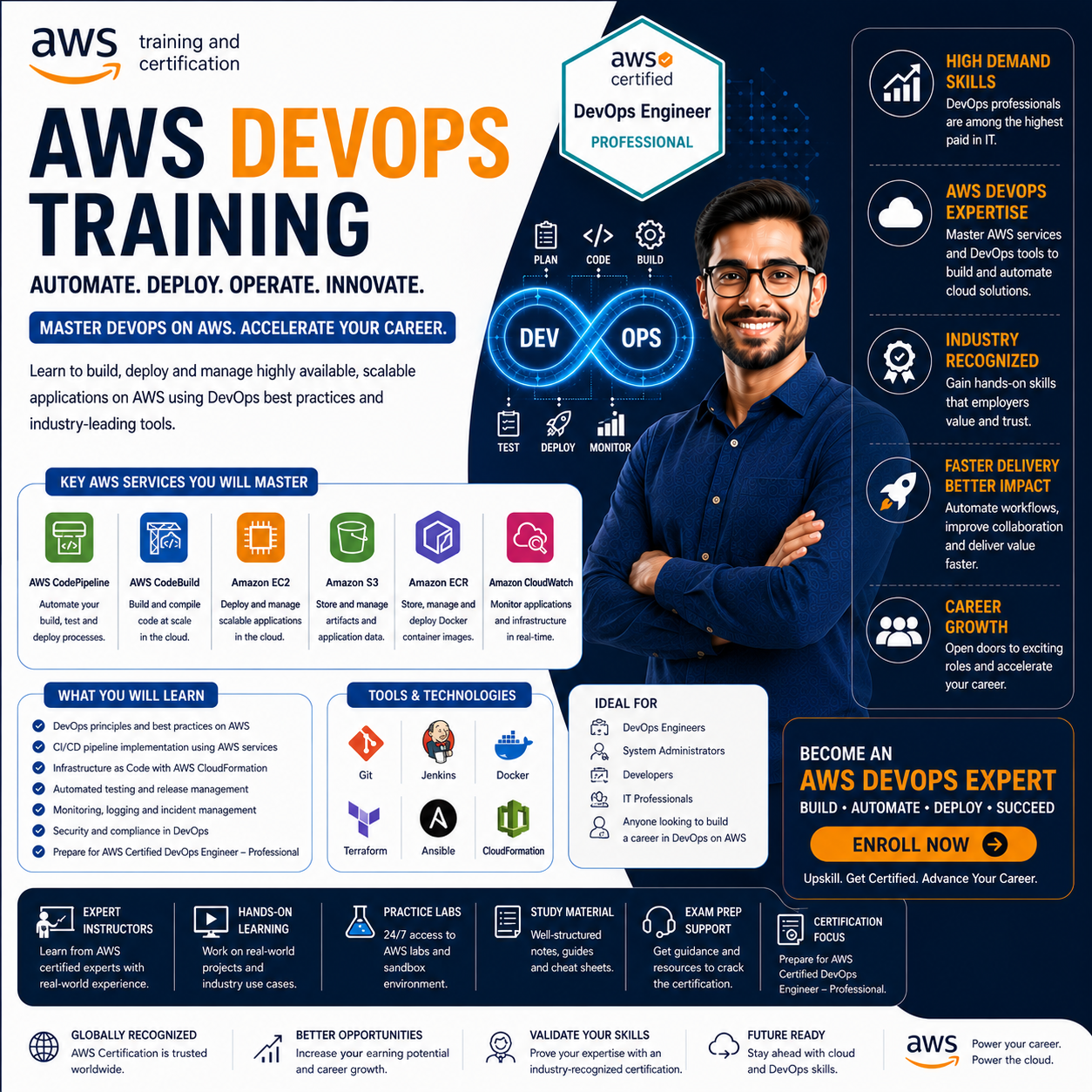
AWS DevOps training courses bridge the gap between cloud computing and automated software delivery by teaching you how to build, deploy, and manage secure applications at high velocity. Whether you choose free self-paced paths or structured paid certificates, mastering these work...

  • Familiarity with AWS Database Services
  • Understanding of database design concepts
  • Understanding of data modeling for relational or nonrelational databases
  • DevOps Engineers
AWS Develops training Course

Enroll in Next Cohort

Join professionals upskilling with Edutech.

$999
  • Duration 16 Weeks
  • Format Live + Recorded
  • Familiarity with AWS Database Services
  • Understanding of database design concepts
  • Understanding of data modeling for relational or nonrelational databases
  • DevOps Engineers
Reserve My Seat Now

Why Edutech?

  • Weekly mentorship checkpoints
  • Portfolio-grade capstone review
  • Interview acceleration toolkit

Overview

AWS DevOps training courses bridge the gap between cloud computing and automated software delivery by teaching you how to build, deploy, and manage secure applications at high velocity. Whether you choose free self-paced paths or structured paid certificates, mastering these workflows prepares you for the industry standard

Key Features

Familiarity with AWS Database Services

Understanding of database design concepts

Understanding of data modeling for relational or nonrelational databases

DevOps Engineers

DevOps Architects

Operations Engineers

System Administrators

Developers

Curriculum

CURRICULUM

CURRICULUM

1. Course overview

Learning Objective

Learning Objective

Understand the basics of DevOps engineering in an AWS environment.

Topics

  • Course objective
  • Suggested prerequisites
  • Course overview breakdown


2. Introduction to DevOps

Learning Objective

Learning Objective

Learn about the fundamentals in DevOps and how AWS enable to implement a DevOps approach.

Topics

  • What is DevOps?
  • The Amazon journey to DevOps
  • Foundations for DevOps


3. Infrastructure Automation

Learning Objective

Learning Objective

Get an understanding of infrastructure automation in an AWS environment.

Topics

  • Introduction to Infrastructure Automation
  • Diving into the AWS CloudFormation template
  • Modifying an AWS CloudFormation template


4. AWS Toolkits

Learning Objective

Learning Objective

Learn how to configure AWS Command Line Interface.

Topics

  • Configuring the AWS CLI
  • AWS Software Development Kits (AWS SDKs)
  • AWS SAM CLI
  • AWS Cloud Development Kit (AWS CDK)
  • AWS Cloud9


5. Continuous integration and continuous delivery (CI/CD) with development tools

Learning Objective

Learning Objective

Learn about the Continuous Integration and Continuous Delivery (CI/CD) in an AWS environment.

Topics

  • CI/CD Pipeline and Dev Tools
  • Demonstration: CI/CD pipeline displaying some actions from AWS CodeCommit, AWS
  • CodeBuild, AWS CodeDeploy and AWS CodePipeline
  • AWS CodePipeline
  • Demonstration: AWS integration with Jenkins


6. Introduction to Microservices

Learning Objective

Learning Objective

Learn about microservices and their benefits.

Topics

  • Introduction to Microservices


7. DevOps and containers

Learning Objective

Learning Objective

Understand the benefits of using containers.

Topics

  • Deploying applications with Docker
  • Amazon Elastic Container Service and AWS Fargate
  • Amazon Elastic Container Registry and Amazon Elastic Kubernetes service
  • Demonstration: CI/CD pipeline deployment in a containerized application


8. DevOps and serverless computing

Learning Objective

Learning Objective

Learn how to leverage serverless computing.

Topics

  • AWS Lambda and AWS Fargate
  • AWS Serverless Application Repository and AWS SAM
  • AWS Step Functions
  • Demonstration: AWS Lambda and characteristics
  • Demonstration: AWS SAM quick start in AWS Cloud9


9. Deployment strategies

Learning Objective

Learning Objective

Learn to implement continuous deployment strategy in AWS.

Topics

  • Continuous Deployment
  • Deployments with AWS Services


10. Automated testing

Learning Objective

Learning Objective

Understand automated testing in AWS.

Topics

  • Introduction to testing
  • Tests: Unit, integration, fault tolerance, load, and synthetic
  • Product and service integrations


11. Security automation

Learning Objective

Learning Objective

Learn the importance of DevSecOps and security measures inside an AWS environment.

Topics

  • Introduction to DevSecOps
  • Security of the Pipeline
  • Security in the Pipeline
  • Threat Detection Tools
  • Demonstration: AWS Security Hub, Amazon GuardDuty, AWS Config, and Amazon Inspector


12. Configuration management

Learning Objective

Learning Objective

Understand the configuration management process in AWS.

Topics

  • Introduction to the configuration management process
  • AWS services and tooling for configuration management


13. Observability

Learning Objective

Learning Objective

Understand why observability matters and how to use AWS tools to help with it.

Topics

  • Introduction to observability
  • AWS tools to assist with observability


Who Can Do

Ideal for

  • AWS CodePipeline: Orchestrates the automated phases of your release process.
  • AWS CodeCommit: Secure Git-based repositories used for hosting source code.
  • AWS CodeBuild: Compiles source code, runs automated tests, and produces packages.
  • AWS CodeDeploy: Automates application deployments to EC2, ECS, or AWS Lambda.
  • AWS CloudFormation: Models and provisions infrastructure using JSON or YAML templates.
  • Amazon CloudWatch: Monitors applications, collects metrics, and configures automated alarms.
  • AWS Systems Manager: Centralizes operational data and automates patching across server fleets.
  • Amazon ECS / EKS: Runs and scales Docker containers using native tools or Kubernetes.
  • Infrastructure as Code (IaC): Writing code to build networks, servers, and databases automatically.
  • CI/CD Pipeline Design: Crafting workflows that automatically test and deploy code with zero downtime.
  • Containerization: Packaging applications and all dependencies into lightweight Docker containers.
  • Linux Administration: Navigating command lines, configuring servers, and writing Bash automation scripts.
  • Git Version Control: Managing code branches, handling merge requests, and isolating feature releases.
  • Deployment Strategies: Executing risk-free releases using Blue/Green, Canary, or Rolling deployment methods.
  • Security & Compliance: Securing systems using the principle of least privilege via AWS IAM.

FAQ

2. What practical skill sets can I expect to have upon completion of this course?

The AWS certified DevOps engineer training is an advanced level training course that teaches you to use DevOps practices and tools. It will teach you:

  • Continuous integration (CI)
  • Continuous delivery (CD)
  • Infrastructure as code
  • Microservices
  • Monitoring and logging
  • Communication
  • Collaboration
Enroll Now