
Applied Agentic AI Course
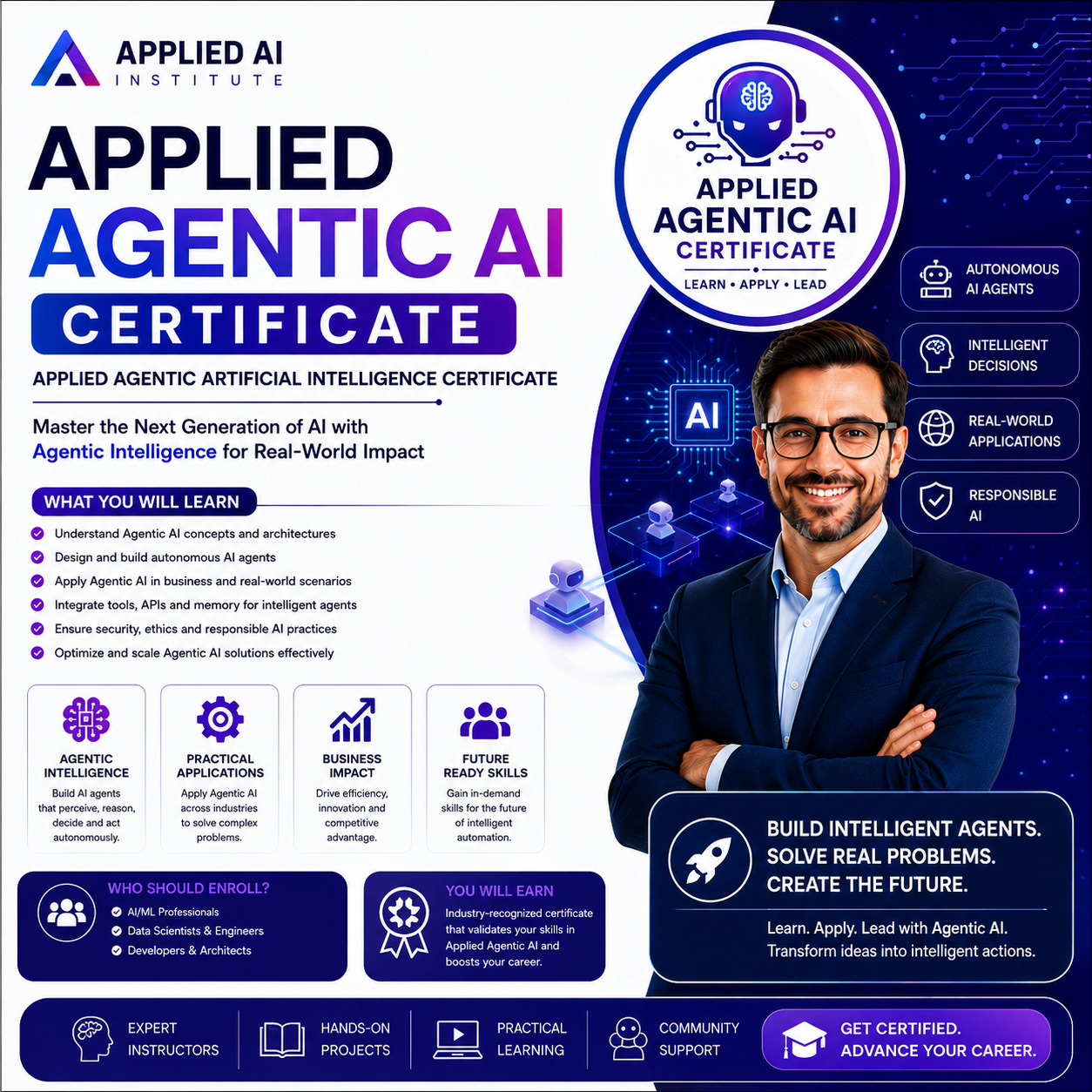
Forge Your Path in AI
Learning Roadmap
1. Week 1 - LLM Foundations & System Thinking
Understand how LLMs work - Transformer intuition (simplified), Attention mechanism concept, Tokenization & embeddings, Context window limitations, Hallucination causes, RAG failure modes (intro), Prompt vs Retrieval vs Fine-Tuning - overview comparison enough to engineer systems around them.
Topics
- Traditional AI vs Generative AI -paradigm shift explained
- Transformer architecture: attention mechanism, layers, context
- Tokens, embeddings, and context windows - engineering implications
- How LLMs generate text: next-token prediction, temperature, sampling strategies
- LLM limitations: hallucinations, knowledge cutoff, context degradation
- Introduction to information retrieval: why LLMs alone aren't enough
- Overview: OpenAI vs Google Gemini vs Anthropic Claude - capability map
- Safety, responsible AI, and deployment considerations
Hand-ons
- OpenAI Python SDK
- Google Gemini SDK
- Anthropic Claude SDK
- tiktoken
- Visual Studio Code/ Google Colab
Project
Multi-SDK LLM Playground
Build a unified interface that queries OpenAI, Gemini, and Claude simultaneously and compares responses side by side.
2. Week 2 - Prompt Engineering & Structured Output
Master advanced prompting techniques and build systems that produce reliable, structured, evaluable outputs.
Topics
- Zero-shot, few-shot, and chain-of-thought (CoT) prompting - when to use each
- Tree-of-Thought (ToT) and self-consistency prompting
- Role prompting and persona design for consistent behavior
- Designing output constraints: format, length, tone, schema
- Structured responses: JSON schema enforcement, typed outputs
- Function calling and tool use: mechanics and design patterns
- Prompt injection: attack vectors and defense strategies
- Evaluation-driven iteration: test → measure → improve loops
- Introduction to prompt versioning and management
Hand-ons
- OpenAI JSON mode
- Open Ai Playground/Clause Console/Google Ai studio
- LangChain PromptTemplate
- OpenAI Evals (intro)/Claude Console Prompt generator
- PromptLayer
Project
Call Center Transcript Sentiment Classifier
Build a production-grade sentiment + intent classifier for call center transcripts using structured output, function calling, and an evaluation harness to measure accuracy.
3. Week 3 - LLM SDK Mastery & RAG: Foundations to Production
Master SDK capabilities, build a full production RAG pipeline with hybrid search, reranking, RAGAS evaluation, and LangSmith observability.
Topics
- Advanced SDK usage: streaming, async calls, retry logic, rate limiting
- JSON schemas, connectors, and tool calls across OpenAI/Gemini/Anthropic
- Why RAG is essential for enterprise AI — the knowledge freshness problem
- End-to-end RAG pipeline architecture
- Embeddings deep dive: how they work, how to choose the right model
- Introduction to information retrieval: keyword (TF-IDF/BM25) vs semantic search
- Vector databases: internals, HNSW, ANN algorithms
- Chunking strategies: fixed, semantic, recursive, document-aware
- Two-stage retrieval: retrieve-then-rerank with cross-encoders · RAGAS evaluation: faithfulness, relevance, completeness · LangSmith observability and tracing
Hand-ons
- LangChain (RAG chains)
- FAISS / ChromaDB
- OpenAI Embeddings API
- File Search SDK
- RAGAS
- LangSmith / LangFuse
Project
Company Knowledge-Base Chatbot
Complete Build a fully production-grade knowledge-base chatbot: ingest PDFs, websites, and proprietary data, implement hybrid search and reranking, evaluate with RAGAS, and trace with LangSmith
4. Week 4 - Building AI Agents
Build structured AI agents that reason, use tools, maintain memory, and handle failures gracefully.
Topics
- Core components of an AI agent: roles, memory, tools, autonomy, goals
- Agent types: Researcher, Writer, Planner, Analyzer — design patterns
- ReAct framework: Reasoning + Acting in a loop
- Chain-of-Thought vs ReAct vs Tool Use — when to use which
- Tool calling deep dive: function schemas, tool orchestration, tool chaining
- Memory systems: short-term (context), long-term (vector store), episodic
- Connecting agents to APIs, databases, browsers, and file systems
- Memory patterns and structured context passing
- Autonomy levels and safe task-scoping
Hand-ons
- LangChain Agents
- Google ADK
- OpenAI Function Calling
- Anthropic Tool Use
- Mem0 (memory)
- Guardrails AI
Project
Researcher-and-Summarizer Agent + Customer Care Agent
Build two agents: (1) A Researcher-and-Summarizer that searches, reads, and synthesizes information autonomously. (2) A Customer Care Agent that uses tool calling to fetch live order information from.
5. Week 5 - Multi-Agent Systems & Google ADK
Design multi-agent architectures and build production coordinator patterns using CrewAI and Google ADK.
Topics:
- Multi-agent architectures: sequential, parallel, hierarchical patterns
- Role-based agents: specialist vs generalist design
- Delegation logic: how agents assign and route sub-tasks
- Coordinator–dispatcher architecture for production workflows
- Passing context and outputs across agent boundaries
- Background agents vs interactive agents
- File persistence using structured Markdown and JSON reports
- Building custom function tools: financial APIs, file writers, data fetchers
- Designing scalable multi-agent orchestration patterns
Hand-ons
- CrewAI
- Google ADK
- LangGraph (multi-agent)
- Open AI SDK
- OpenAI Assistants API
- Model Context Protocol (MCP): what it is and why modern agents use it
Project
Financial News Research Coordinator
Build a Financial News Research Coordinator using Google ADK: a coordinator agent dispatches specialized sub-agents (news fetcher, sentiment analyzer, report writer) and produces a structured investment.
Week 6 : MCP, Voice, Multimodal, Evaluation & Capstone
Master MCP architecture, build voice G multimodal agents, evaluate and debug agentic systems, and deliver a fully integrated end-to-end Capstone project.
Evaluating agents end-to-end: task completion rate, tool use accuracy, response quality · Debugging agentic systems: tracing execution and identifying failure points · Reliability patterns: idempotency, retries, fallback strategies · Capstone architecture: RAG + Agents + Multi-Agent + MCP integrated.
Topics Covered:
- MCP architecture: client, server, and transport layer
- Registering tools, services, and capabilities through MCP servers
- How MCP simplifies connecting agents to databases, APIs, and internal systems
- MCP vs traditional tool-calling: comparison and migration path
- Integrating MCP into multi-agent applications
- Gemini multimodal capabilities: vision, audio, documents
- Voice agent architecture: speech-to-text → LLM → action → text-to-speech Hand-ons Practical:
- MCP SDK
- Gemini Multimodal API
- Google Speech-to-Text / TTS
- LangSmith
- Helicone
- RAGAS · WGB · Guardrails AI · FastAPI Project:
MCP-Powered Agent + Voice Assistant + Capstone Build three deliverables:
- MCP server connecting agents to databases and APIs.
- Voice-enabled multimodal assistant.
- CAPSTONE: fully integrated multi-agent application combining RAG, tool- using agents, evaluation loops, and production deployment
AI Program Intelligence
1. What is this course all about?
The Applied Agentic AI Certification is a 6-week program designed to help you build autonomous AI systems that think, plan, and execute.
The course focuses on:
- Understanding LLM foundations (transformers, attention, embeddings, hallucinations)
- Building real systems like Mini-ChatGPT
- Designing and deploying RAG (Retrieval-Augmented Generation) pipelines
- Developing single-agent and multi-agent AI systems
- Implementing memory, planning, tool usage, and guardrails
- Fine-tuning models for performance, cost, and reliability
- Designing enterprise-grade AI agent architectures
- It is highly hands-on and project-driven, covering tools like PyTorch, OpenAI API, LangChain, FAISS, CrewAI, FastAPI, and more.
2. What are the benefits of doing this course?
You can expect to get a wide range of benefits from doing the Applied Agentic AI Certification training, these benefits will include:
Technical Benefits
- Build Mini-ChatGPT from scratch (simplified implementation)
- Create full RAG pipelines
- Design and implement multi-agent systems
- Learn decision frameworks (RAG vs Fine-tuning vs Prompting)
- Gain production optimization skills (latency, cost, observability)
- Work with 10+ industry-grade AI tools
- Complete a real-world enterprise capstone project
3. How essential is this Agentic AI training?
This course is essential because:
- AI is moving beyond chatbots to autonomous agent systems that reason and act.
- Companies need engineers who can design complete AI systems, not just write prompts.
- It teaches practical system design (architecture decisions, cost trade-offs, latency optimization).
- You learn when to use prompting, RAG, or fine-tuning, a critical real-world skill.
- It prepares you for emerging high-paying roles in AI engineering and GenAI systems.
In short, this course focuses on building real-world, production-ready AI agents, which aligns directly with current industry demand.
Industry-Endorsed AI Credentials
Your mastery is validated by the pioneers of modern technology.


The AI Ecosystem
Deepen your expertise across the full spectrum of artificial intelligence and machine learning.